Best Cooler for Camping: Ice Chests and Powered Picks
How to choose a cooler for car camping: size, ice retention, packing, bear country rules and when a powered fridge makes sense, plus four models that fit.
At a glance
For most car campers, the YETI Tundra 45 is the pick, since it locks and is IGBC certified for bear country. The RTIC 52 QT Ultra-Light carries more for less weight, and the Pelican Elite 50 suits rough, hard-used trips. On long road trips, the Dometic CFX3 45 removes the need for ice.


A camping cooler has a harder job than a picnic cooler. It sits in a hot car, then in a campsite with no shade at noon, and it gets opened every time someone wants a drink. It may also have to survive a bear, a dusty truck bed, and a fifty-yard carry from the parking spot. This guide covers what matters for that kind of trip: how big the cooler should be, how to pack it, what the food safety line is, how bear country changes the choice, and which models from our lineup fit which camper.
We do not handle the products we cover. We compare the specs and measurements that manufacturers and independent outlets have published, and we say where each figure comes from. For the full ranking of all eight coolers on this site, see our best coolers of 2026.
How Big a Camping Cooler Should Be
Sizing starts with a mistake almost everyone makes: reading the quart or can number as if it were the space for food. It is not. A listing that says a cooler holds 54 cans is counting cans packed tight with nothing else inside. OutdoorGearLab lists 54 cans for the YETI Tundra 45 and 61 cans for the RTIC 52 QT Ultra-Light. Once you add ice, those numbers drop sharply.
A simple way to plan is the common 2:1 ice ratio, meaning two parts ice to one part food and drinks. That leaves contents with about a third of the interior. So a cooler that is labeled 45 to 52 quarts is a realistic size for two people over a weekend, or a family of four for a day trip. For a long weekend with a group, many campers carry two coolers: a bigger one for food that stays closed, and a smaller one for drinks that gets opened constantly.
Usable space also differs from the label. OutdoorGearLab measured about 35 quarts of usable space inside the YETI Tundra 45 and 49 quarts inside the RTIC 52 QT Ultra-Light. Thick insulation takes up room, which is why two coolers with similar names can hold very different amounts. Read the interior dimensions, not just the name.
Weight matters too, because a camping cooler gets lifted into and out of a vehicle every time. According to OutdoorGearLab, the RTIC weighs 21.6 lbs empty and the Tundra 45 about 29.6 lbs, so the Tundra is roughly 8 lbs heavier before you put anything in it. Add 20 lbs of ice and food and you have a two-person carry.
How to Pack for Maximum Ice Life
Ice life is mostly packing technique. The same cooler can last a weekend or a day depending on how you load it. These habits come up again and again in cooler guidance, and none of them cost anything.
- Pre-chill the cooler. Bring it inside the night before and put a sacrificial bag of ice or a few frozen jugs in it. A warm cooler wastes the first several pounds of your ice just cooling its own walls.
- Pre-chill everything you put in. Cold drinks and refrigerated food go in cold. Meat that you plan to eat on day three can go in frozen.
- Use a high ice ratio. Aim for roughly two parts ice to one part contents, as described above. Fill empty space, because air warms the cooler faster than ice does.
- Layer it. Block ice or frozen water jugs go on the bottom, food on top, and cubed ice fills the gaps. Frozen jugs double as drinking water when they melt.
- Keep food out of the water. Use sealed containers or zip bags, or a dry goods basket if the cooler comes with one. The YETI Tundra 45 includes a basket, as noted on our Tundra 45 profile.
- Keep it shaded and closed. Put the cooler in the shade, cover it with a blanket or tarp, and keep it off hot ground. Every opening lets warm air in. Pack drinks in their own cooler if you can.
The 40°F Rule
For food safety, the number to remember is 40°F. OutdoorGearLab reports two kinds of results for coolers it measures: how many days food stays at or below 40°F, and how many days drinks stay below 50°F. The first is the one that matters for meat, dairy, eggs and leftovers.
The gap between the two numbers is large. OutdoorGearLab measured the YETI Tundra 45 at about 4.1 days of food-safe temperatures and 4.5 days of cold-drink temperatures, and the RTIC 52 QT Ultra-Light at about 5.8 and 6.3 days. Those are controlled measurements by one outlet, and your results will be shorter if the cooler sits in a sunny car, is opened often or is packed with less ice. Put an appliance thermometer inside and check it. If perishable food has been above 40°F for a long time, do not gamble with it.
Maker claims are a different matter. RTIC advertises a much longer ice life than OutdoorGearLab measured for the same cooler, which is a useful reminder to treat day counts from a brand as a ceiling, not a promise.
Bear Country and the IGBC List
If you camp in grizzly or black bear habitat, the cooler you carry may be part of the rules. The Interagency Grizzly Bear Committee (IGBC) says on its website that bear-resistant products help keep bears from becoming food-conditioned, and it maintains a Certified Bear Resistant Products List. The IGBC’s home page links to that list, so check it for current models.
According to OutdoorGearLab, the YETI Tundra 45 is IGBC certified, and the certification depends on locking it with YETI’s padlocks. The padlocks are sold separately, and OutdoorGearLab notes that the keyhole faces the ground, so the key can be hard to insert. A certified cooler locked correctly can serve as your food storage in places that allow it, which saves you from carrying a separate canister.
Two cautions. First, certification covers a specific product in a specific configuration. If you leave the locks off, you have a regular cooler. Second, the rules belong to the land manager, not to the cooler maker. Some campgrounds require food storage lockers, some accept certified containers, and some require both. Read the park or forest page before you go, and do not assume any cooler on this page meets a local rule unless the certified list or the land manager says so.
When a Powered Cooler Makes Sense
An ice chest is simple, but ice is a recurring chore on a long trip. If you are driving for a week, camping at a different spot every night and passing through towns that are far apart, a compressor fridge removes ice from the plan. It also keeps food dry, because there is no meltwater.
The trade-off is power. A compressor cooler needs a 12V socket, a power station or a campsite hookup. If your vehicle battery is the source, use the battery protection setting, because a drained starter battery ends the trip.
The Models That Fit
YETI Tundra 45: The Pick for Bear Country
A rotomolded hard cooler that is IGBC certified when locked with padlocks. A fit for campers who want one rugged cooler for years of trips.
The Tundra 45 is a premium ice chest. OutdoorGearLab lists it at 54 cans, with exterior dimensions of about 25.5 x 16.0 x 15.5 inches and about 35 quarts of usable space. It is heavy for its size and has no wheels, with rope and molded handles for carrying. In OutdoorGearLab’s measurements it kept food below 40°F for about 4.1 days, which the outlet calls average for its size.
Its case rests on durability, locking corners and the IGBC certification. If you camp in bear country or hunt and fish where food storage matters, it addresses the problem directly. If you only camp a few weekends a year in places with no bear rules, a lighter cooler will do the job. Read the YETI Tundra 45 profile for the details and caveats.
RTIC 52 QT Ultra-Light: For Space and Light Weight
An injection-molded hard cooler with about 49 quarts of measured usable space and a lighter body. A fit for campers who want room without a heavy lift.
This is the cooler for people who want to carry more food and less cooler. OutdoorGearLab measured it at 21.6 lbs empty with 49 quarts of usable space and 61 cans, and it kept food at safe temperatures for about 5.8 days, which is longer than it measured for the Tundra. RTIC’s own claim is much longer, which the outlet did not reproduce.
The trade-offs: no wheels, a lighter-duty build than a rotomolded chest, and no bear certification listed in our sources. It suits campers who drive to the site and want the most capacity for the weight. See the RTIC 52 QT Ultra-Light profile.
Pelican Elite 50: Built for Rough Use
A rotomolded 50-quart hard cooler with about 2 inches of insulation and a lifetime guarantee, according to Pelican. A fit for rough trips, trucks and boats.
Pelican describes the Elite as a rotomolded cooler with about 2 inches of polyurethane insulation and a freezer-grade gasket, and it backs it with a lifetime guarantee. Its handles double as tie-down points, and it has a tethered drain plug, a bottle opener and a fish scale on the lid. Expect the weight of a rotomolded chest. Our sources do not list a bear certification for it, so for bear country look at the Tundra instead. It suits campers who also fish or boat. The details are on the Pelican Elite 50 profile.
Dometic CFX3 45: For Long Road Trips Without Ice
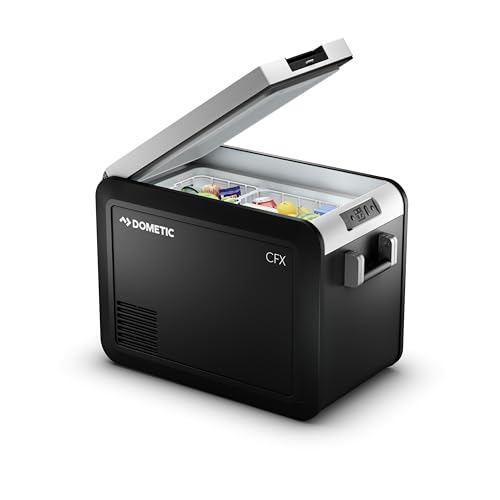
A compressor fridge/freezer that runs on 12/24V DC or household AC, with no ice to buy. A fit for multi-day road trips and overlanding.
According to Dometic, the CFX3 45 has 46 liters (about 49 quarts) of capacity, rated at 67 standard cans, and cools from about 68°F ambient down to about -8°F. It runs on 12/24V DC or 100-240V AC, and Dometic describes a three-stage battery protection system meant to protect a starter battery, along with an app for temperature control over Bluetooth or Wi-Fi. Dometic lists the net weight at 42.78 lbs, so this is not a cooler you carry down to the lake.
It has no battery built in. It is for people who keep the cooler in a vehicle or run it from a power station or a hookup. Dometic’s FAQ suggests a 100W or larger solar panel and a battery of at least 40 Ah for planning off-grid use. It sits in the premium tier. The Dometic CFX3 45 profile goes through the power details.
Quick Picks by Camper
- Camps in bear country or hunts: the Tundra 45, with locks.
- Wants capacity at the lowest carry weight: the RTIC 52.
- Camps, fishes and boats: the Pelican Elite 50.
- Drives for days and does not want ice: the Dometic CFX3 45.
Whichever you choose, the habits matter more than the logo: pre-chill, pack at a high ice ratio, keep it shaded and closed, and check the temperature against the 40°F line.
Sources
- YETI Tundra 45 measurements and specs (OutdoorGearLab), independent published reviews and measurements
- RTIC Ultralight 52 measurements and specs (OutdoorGearLab), independent published reviews and measurements
- Interagency Grizzly Bear Committee home page (IGBC)
- Dometic CFX3 45 official product page
Frequently asked questions
How big a cooler do I need for a weekend of car camping?
Think in terms of what is left after the ice. A common packing ratio is two parts ice to one part food and drinks, which means contents fill only about a third of the inside. A cooler that lists 54 cans empty, like the YETI Tundra 45 according to OutdoorGearLab, holds far fewer once it is packed that way. For a couple on a weekend, a cooler in the 45 to 52 quart class is usually enough. Add a second small cooler for drinks if the group is bigger.
What temperature should food in a cooler stay below?
40°F. OutdoorGearLab uses 40°F as its cutoff for food-safe days, and that is the line US food safety guidance draws for perishables like meat and dairy. Put an appliance thermometer inside and treat anything that has been above 40°F for a long stretch with caution.
Does a cooler need to be bear-resistant?
Only if you camp where the land manager requires it. The Interagency Grizzly Bear Committee (IGBC) keeps a certified bear-resistant products list. According to OutdoorGearLab, the YETI Tundra 45 is IGBC certified when it is locked with YETI's locks. Rules differ by park and forest, so check the rules for your campground before you rely on any cooler.
Is block ice better than cubed ice?
Block ice melts more slowly because it has less surface area, so many campers put a block or frozen jugs on the bottom and fill gaps with cubes. Treat this as common practice rather than a guaranteed result.
Should I drain the meltwater?
It depends on the food. Keep food in sealed containers or bags so it never sits in water. Cold meltwater still helps keep the inside cold, so many campers drain only when the water rises enough to reach packages. The most important habit is to keep the lid closed.
When is a powered cooler worth it for camping?
When you are on the road for several days, have a vehicle or power station to run it, and do not want to buy ice every day. A compressor fridge such as the Dometic CFX3 45 needs power, because it has no battery built in, according to Dometic. For a weekend at one campsite, an ice chest is simpler.