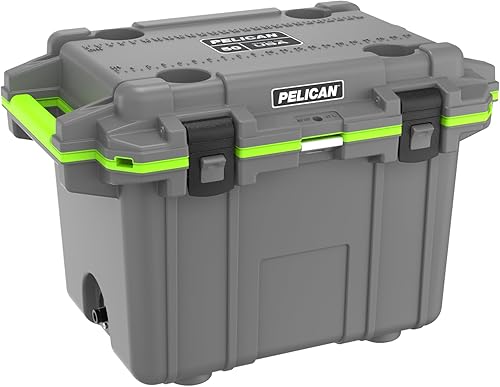
The Pelican Elite 50 is a rotomolded hard cooler from a company better known for protective cases. It is a heavy-duty, thick-walled ice chest meant to last, with a guarantee that Pelican describes as lifetime. This profile summarizes what is published about it, explains where the figures disagree, and says who should buy it. For the whole lineup, see our best coolers of 2026 comparison.
We do not handle the products we cover. We compare published specifications and outside reporting, and we name the source of each claim.
The Short Version
If you want a cooler you will not have to replace, the Elite 50 is a strong contender. It has thick insulation, a gasket like the one on a chest freezer, latches built to be pulled tight and a guarantee that covers it for life. Those are the features that justify a premium ice chest. The trade-off is weight and bulk. It is a cooler you drive to the water or the campsite, not one you carry a mile. We rank it sixth of eight in our lineup. That is a statement about the cost and the competition from the YETI Tundra 45, not a knock on the build.
Key Specs According to Published Sources
The specifications below come from Australian Geographic’s write-up of the Pelican 50QT Elite. Check them against the listing for the version you buy.
- Capacity: Sold as the 50QT. Australian Geographic gives the capacity as about 50 quarts (47 liters). Other listings, including Amazon’s, may round this to 50 or 52 quarts.
- Dry weight: Roughly 26 lbs (about 12 kg), according to Australian Geographic.
- Exterior size: About 30 x 20.3 x 20.4 inches (762 x 516 x 518 mm).
- Insulation: About 2 inches (50 mm) of polyurethane behind a hard plastic exterior.
- Seal and closures: A freezer-grade gasket on the lid, heavy-duty latches and a lock hasp.
- Hardware: Stainless steel.
- Other features: Handles that double as tie-down points, a drain with a tethered plug, a bottle opener, and a fish scale on the lid.
- Warranty: Lifetime guarantee.
One caution about the numbers: weights and dimensions for Pelican coolers vary between regional pages, retailers and variants. We have not picked one weight and called it settled. Use the figures above as a guide, and check the listing for the version you order.
What the Ice Claim Means
Pelican promotes the Elite line on ice retention. According to Australian Geographic, Pelican claims up to 10 days. The writer said that figure depends on conditions and storage, and did not verify it. What the writer did report was that on a hot three-day trip, the cooler kept ice without a top-up while other campers nearby had to buy more ice on the second day. The article says the cooler “has performed as claimed.”
That is a useful anecdote and a reasonable summary of how to read any ice-retention number. Days of ice depend on how you use it:
- Pre-chill. Bring the cooler’s inside temperature down the night before with a sacrificial bag of ice or frozen jugs.
- Ice ratio. More ice than food, about 2:1 by volume, buys time.
- Block ice and frozen jugs last longer than cubes.
- Shade and cover. Keep it out of direct sun and under a blanket or towel in a car.
- Limit openings. Every lid-open lets warm air in.
Follow these steps and almost any quality hard cooler will do better. A thick wall and a good gasket give you a head start, which is what the Elite is built to provide.
Build and Features
The exterior is a hard rotomolded shell. Inside is about 2 inches of polyurethane foam, which is the same approach premium coolers from other brands use. The lid has a freezer-grade gasket, which is meant to keep warm air out and cold air in. Heavy-duty latches and a lock hasp hold the lid shut, and the hardware is stainless steel.
Several practical details stand out in the Australian Geographic write-up. The handles double as tie-down points, so you can strap the cooler to a boat deck or a truck bed. The drain has a tethered plug, which means you do not lose it in the water. A bottle opener is built in. A fish scale is molded into the lid, which makes this a cooler that fits the fishing crowd. The writer also noted that the lid is solid enough to load gear on top.
Weight, Bulk and Carrying
This is the part buyers should take seriously. Even empty, the Elite 50 is described as hard to carry. Packed with ice and food, the writer called it a two-person job. It also takes up significant cargo space, so measure the trunk, the truck bed or the boat locker before you order. A 30-inch-long chest is a different animal from a 25-inch one.
If you plan to haul a cooler from a parking lot to a beach, down a dock or over uneven ground, think about a wheeled model such as the YETI Roadie 48, or a lighter chest such as the Igloo BMX 52. The Pelican’s strength is protection and insulation, not portability.
Bear Country
Premium hard coolers are often discussed alongside bear resistance. The sources we cite do not mention a bear-resistance certification for this specific model, so do not assume one. If you camp where bears are active, check the Interagency Grizzly Bear Committee’s list of certified products and the rules of the place you are visiting. Following local food-storage rules, such as bear boxes or locked vehicles, matters more than any one cooler.
Who Should Buy It
- Anglers and boaters: The tie-down handles, tethered drain, bottle opener and lid fish scale all point to the water.
- Truck and SUV owners: A cooler that can ride in a truck bed, take a strap and double as a seat or a platform.
- Buyers who keep gear for decades: The lifetime guarantee is the main appeal.
- Campers who value insulation: Thick walls and a good gasket pay off on long weekends.
Who Should Skip It
- Anyone who carries a cooler far. It is heavy, and it has no wheels.
- Buyers who want the lightest, cheapest ice chest. The Igloo BMX 52 is far lighter.
- People who want fridge temperatures without ice. A compressor model such as the Anker SOLIX EverFrost 2 40L does that, at the cost of charging and weight.
Pros and Cons
Pros
- About 2 inches of polyurethane insulation and a freezer-grade gasket
- Lifetime guarantee, according to Pelican as reported by Australian Geographic
- Stainless hardware and a lock hasp
- Tie-down handles, tethered drain plug, bottle opener, fish scale
- Solid lid you can load gear on
Cons
- Heavy and bulky, and a two-person carry when packed
- Premium-tier ice chest
- Weight and size figures vary between listings
- No bear-resistance certification mentioned in the sources we cite
What to Check Before You Buy
- Variant: Pelican sells the Elite 50QT in several colors. Confirm the one in the listing, since specs can vary.
- Weight and dimensions: Compare the figures on the listing with the space in your vehicle.
- Warranty terms: Read Pelican’s current lifetime guarantee wording.
- Carrying plan: Decide who will lift it, and where it will ride.
- Bear rules: Check certification and local rules if bears are a factor.
You can see the current price and variants here: Pelican Elite 50 on Amazon. Buying through our link may earn a commission at no cost to you.
Sources